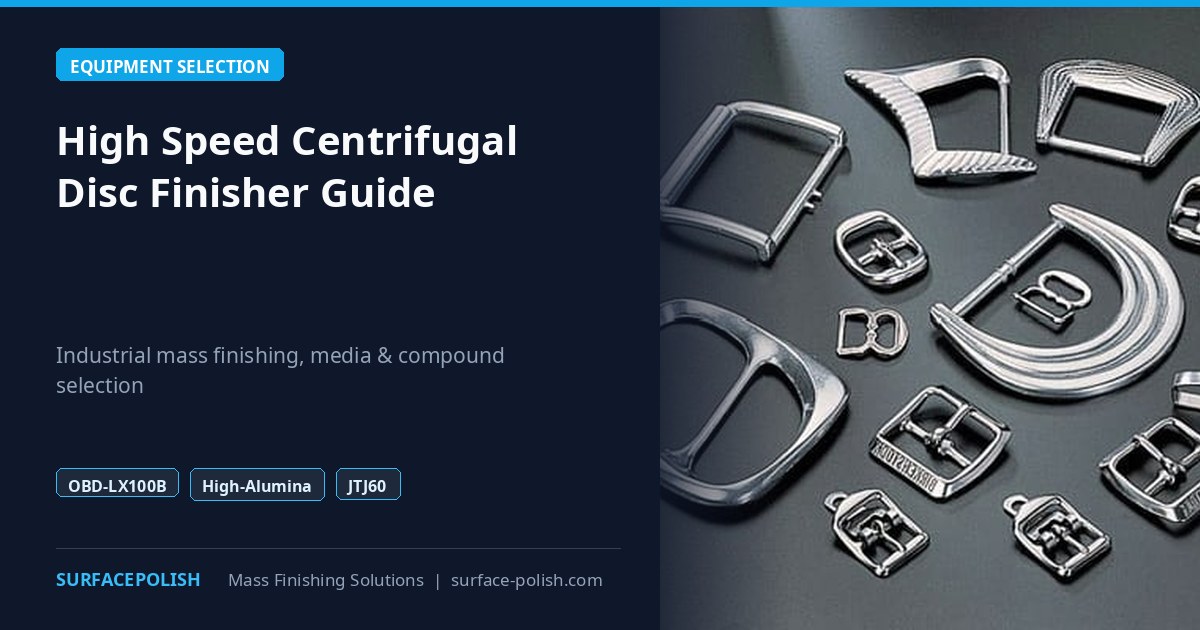
When small stamped belt buckles, shoe clasps, connecting chain links, safety pins, and spark-plug terminals bottleneck inside slow conventional tumblers, a high speed centrifugal disc finisher multiplies abrasive cutting pressure cleanly across compact batches. Using a rotating bottom spinner disc inside a stationary polyurethane-lined drum, platforms like OBD-LX100B and LLB50 drive a dense toroidal vortex that shears heavy stamping burrs and refines surface luster rapidly. SurfacePolish (Xiamen Jin Tai Jin Grinding Technology Co.,Ltd.) applies 200,000+ verified finishing trials to configure OBD-LX100B high-speed centrifugal finishing machines and LLB50 disc units for crisp edge radiusing, minimal disc-gap wear, and consistent small-part throughput.

How Toroidal Flow Accelerates Small-Part Deburring Inside Disc Finishers
Unlike a vibratory finishing machine that moves media gently via eccentric bowl oscillation, a high speed centrifugal disc finisher converts rotary motor torque directly into high-velocity helical turnover. Understanding that toroidal flow explains both its speed advantage and its critical maintenance points.
Centrifugal Throw vs. Stationary Drum Braking Action
At the bottom of the cylindrical work drum, a precision-balanced spinner disc flings the wet mixture of parts, ceramic media or plastic media, and compound outward toward the stationary polyurethane drum wall. As the mass climbs the vertical wall, gravity and wall friction slow it down and fold it inward down the center vortex, creating intense, continuous sliding shear across every part face.
Why Small Stamped Clips, Buckles & Chain Links Finish So Quickly
Small lightweight stampings—such as shoe buckles, stamped clips, and spark-plug connectors—carry very little self-weight inside a standard ZL vibratory bowl, causing them to float gently rather than scrub hard against stones. High-G toroidal acceleration inside an OBD-LX100B or LLB50 centrifugal finishing machine forces abrasive stones tightly against small workpieces regardless of part mass, compressing multi-hour tumbling runs into rapid, predictable batches.
Matching Variable Speed Drives to Alloy Hardness & Edge Fragility
Variable-frequency speed control lets operators dial high spinner RPM for aggressive 304 stainless or carbon steel burr removal, then drop speed smoothly for cushioned JTJ60 or HM3 brightening on brass buckles and aluminum clips without rolling delicate fastener prongs.
| Small-Part Application | Material & Primary Defect | Recommended Disc Platform | Media & Compound Choice | Key Process Advantage |
|---|---|---|---|---|
| Stamped belt & shoe buckles | Brass / zinc die-cast flash | LLB50 / OBD-LX100B disc |
Resin plastic media + HM3 / JTJ60 |
Fast edge blend without peening |
| Connecting chain links & clips | Carbon / 304 stainless burrs |
OBD-LX100B high-speed disc |
Fine ceramic media + LC10 / JTJ20 |
Rapid burr root removal across links |
| Spark-plug terminals & pins | Machined thread & crimp burrs | LLB50 disc + 35A spin dryer |
High-alumina / ceramic media + JTJ60 |
Uniform radiusing + bright sheen |
| Delicate brass contacts & clasps | Thin-wall bending risk | LLB50 low-RPM + OBD-60 magnetic |
Fine plastic media + HM3 |
Preserves spring-clip geometry |
| Oily stamped hardware lots | Heavy press-drawing lubricants | Ultrasonic cleaner + OBD-LX100B |
Pre-wash then ceramic media + LC10 |
Clean drum gap & glaze-free cut |
Managing Disc-to-Wall Gap Clearance, Seal Rings & Drain Flush
The single most critical mechanical tolerance on any high speed centrifugal disc finisher is the narrow annular gap separating the spinning bottom rotor from the stationary outer drum wall. Neglecting that gap causes jammed media slivers, torn polyurethane rings, and premature bearing wear.

How Clean Water Flush Protects the Rotor-Wall Seal Gap
During operation, continuous clean water and compound mist pass through the lower seal gap to lubricate the sliding interface and flush ground metal dust and tiny worn media chips cleanly out of the drum. Starving the lower flush line allows hard abrasive grit to pack tightly inside the gap, scoring both the spinner edge and stationary wall liner.
Preventing Thin Stampings & Broken Media from Wedging in the Gap
Flat stamped washers, thin shim clips, and worn-down ceramic media slivers can slip into an over-wide rotor gap, locking the disc or shredding the polyurethane seal ring. Enforcing disciplined media screening and replenishment to remove undersized stone chips—paired with regular feeler checks of rotor-gap clearance—keeps the seal ring tight and trouble-free.
Checking Ceramic vs. Polyurethane Spinner Wear Rings
Heavy ceramic media cutting on stainless chain links gradually wears the outer rim of the spinner disc and lower drum wall. Inspecting gap uniformity weekly and adjusting or replacing wear rings on schedule prevents sudden mid-batch stalls and protects drive bearings from radial overload.
Selecting High-Alumina, Ceramic Media & Plastic Media for Disc Vortexes
High-velocity toroidal flow amplifies both cutting efficiency and media attrition rate. Choosing tough, non-lodging media matched to your alloy prevents broken stone wedges and keeps surface finish consistent across every load.

High-Alumina Spheres & Cylinders for Bright Burnishing & JTJ60 Polish
When finishing hardened steel pins, spark-plug terminals, or bright stainless clasps inside an OBD-LX100B centrifugal finishing machine, dense high-alumina spheres and fine cylinders resist rapid breakdown under high-G sliding forces while burnishing surfaces to a crisp specular sheen with JTJ60 or JTJ50 chemistry.
Tough Ceramic Media vs. Cushioned Plastic Media Cones
Use fast- or medium-cut aluminum-oxide ceramic media when shearing work-hardened 304 stainless or carbon steel stamping burrs. Switch immediately to lightweight resin plastic media cones and pyramids when processing brass belt buckles, zinc die castings, or soft aluminum clips so high-speed toroidal turnover never creates peening craters.
Enforcing Non-Lodging Sizing Rules Inside High-Velocity Flows
Under centrifugal acceleration, slightly undersized triangles slam far deeper into buckle slots and chain-link pin holes than in gentle bowls. Verify every slot width against non-lodging media sizing rules upfront so stones bridge safely across all openings.
Compound Dosing (JTJ60, LC10, HM3), Pre-Wash & 35A Spin Drying
Because disc finishers compress cycle duration dramatically, chemical tumbling compounds must act quickly to keep metallic fines suspended and media faces sharp from start to finish.

Continuous Flow-Through LC10, JTJ60 & HM3 Dosing
Recirculating stagnant soapy water inside a fast centrifugal drum turns the vortex into thick gray paste within minutes, glazing stones and dulling brass trims. Metered flow-through dosing of LC10 (deburring), JTJ60 (fine metal polishing), or HM3 (brightening)—calibrated alongside water hardness in mass finishing—flushes abraded grit cleanly through the bottom drain.
Upstream Ultrasonic Cleaner & MC8 Descaling Before Disc Loading
Oily cold-headed pins or heat-treat-scaled chain links foul centrifugal drum gaps and glaze high-alumina media instantly. Degrease oily lots in an ultrasonic cleaner bath first, and strip heavy ferrous scale with MC8 descaling chemistry before running bright finishing cycles.
Immediate 35A / 70A Centrifugal Drying & Optional Dry Organic Luster
High-speed disc batches finish quickly—meaning wet steel clips and brass buckles pile up fast unless drying keeps pace. Spin rinsed parts straight inside a 35A or 70A centrifugal dryer to stop flash rust and water spots, then transfer cosmetic buckles to a dry walnut shell or corncob (8#-80#) barrel when deep mirror warmth is desired.
Unloading, External Screening & Multi-Stage Cell Integration
Most high-speed disc finishers tilt or open a bottom/side chute to discharge parts and media together onto an external screener, making smooth downstream handling essential for short-cycle ROI.
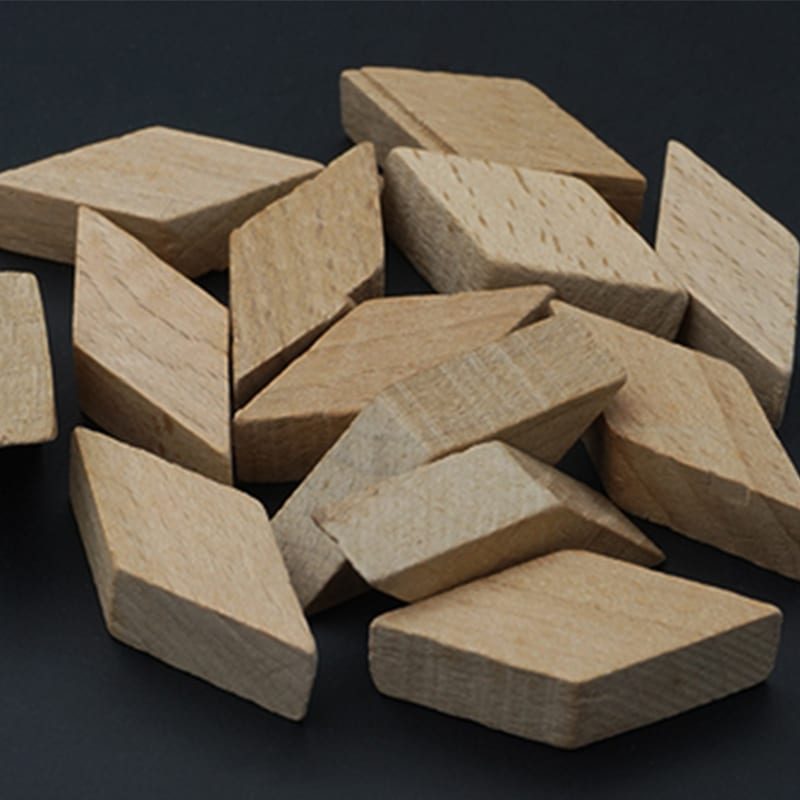
Tilting Drum Discharge onto External Two-Deck Screeners
On LLB50 and OBD-LX100B cells, tipping the drum onto an external two-deck vibratory screener separates finished small parts cleanly from ceramic media or high-alumina spheres while automatically scalping worn undersized fragments into a lower tray. Adding a magnetic drum separator makes carbon-steel clip separation completely hands-free.
Pairing Disc Finishers with OBD Magnetic Polishers & ZL Bowls
When small stamped hardware also has blind internal holes or needs secondary dry mirror buffing, combine an OBD-LX100B disc for rapid exterior deburring with an OBD-60 magnetic polishing machine for internal bores or a rotary barrel tumbler for final dry luster.
Auditing First-Article Roughness & Edge Uniformity
Verify first-article clips, terminals, and buckles against surface finish conversion chart targets and optical edge checks before releasing multi-shift production runs.
| Disc Finisher Issue | Probable Floor Cause | Fast Corrective Fix | Preventive Maintenance Rule |
|---|---|---|---|
| Spinner disc stalls or drags | Grit packed in rotor-wall seal gap | Flush gap; screen out undersized chips | Maintain steady lower water flush |
| Parts wedge between disc & wall | Gap worn too wide or thin flat shims | Adjust/replace seal ring; resize load | Check disc-wall gap weekly |
| Dull, gray finish on brass buckles | Foam stall or oily incoming parts | Pre-wash ultrasonically + fresh HM3 |
Calibrate flow-through dosing pump |
| Peening dings on soft alloy clips | Excess RPM or heavy ceramic stones | Lower speed; switch to plastic media |
Lock alloy-specific RPM recipes |
Contrasting Disc Finishers with LLF120 Barrels & Rotary Barrel Lines
Knowing where a high speed centrifugal disc finisher fits alongside planetary barrels and slow rotary drums helps shops build balanced, high-ROI finishing cells.
When to Choose OBD-LX100B Discs vs. LLF120 Planetary Barrels
Open-top OBD-LX100B and LLB50 centrifugal disc finishers excel on high-mix small stampings where fast loading, easy visual checks, and rapid tilting discharge matter most. For ultra-delicate surgical screws, precision watch gears, or heavy isotropic cuts that cannot tolerate any sliding-zone nicks against a stationary wall, a four-barrel OBD-LLF120 planetary centrifugal machine provides zero-wall-collision G-force control.
Integrating Barrel Finishing Process & Isotropic Finishing Workflows
Review our barrel finishing process and isotropic finishing guides to balance batch volume, edge-radius precision, and capital footprint across disc, bowl, and barrel platforms.
Managing Multi-Shift Operator Safety & Ergonomic Loading
Keep wet floor mats dry around tilting disc discharge chutes, use wheeled media hoppers for quick ceramic media to plastic media swaps, and stage dual 35A dryer baskets beside the external screener so operators never strain lifting heavy wet totes.
Troubleshooting Rapid Wear, Foam Carryover & Part Nicking
Disciplined weekly checks keep high-speed centrifugal discs running smoothly at peak G-force without unplanned liner or seal replacements.
Extending Polyurethane Drum Liner & Spinner Disc Service Life
High-G toroidal flow concentrates abrasive wear along the lower drum transition band and outer spinner rim. Maintaining proper liquid flow, keeping media-to-part volume ratio generous, and replacing lower wear rings before steel backing plates expose themselves doubles overall chamber life.
Controlling Soft-Water Foam Inside Fast-Spinning Chambers
Excessive compound concentration in soft tap water whips up thick foam inside high-RPM disc vortexes, floating lightweight parts right out of the active cutting band. Trim LC10 or JTJ60 pump speed slightly and monitor water turnover so the slurry stays fluid and active.
Preventing Thin-Clip Entanglement During High-Speed Rotation
Hooked spring clips and open chain links can tangle into tight balls if dumped dry or under-filled with media. Pre-separating tangled blanks and maintaining full media fill keeps every piece cushioned individually throughout the cycle.
Standardizing Recipe Logs Across High-Mix Hardware SKUs
Documenting exact spinner RPM, media type, compound drip rate, and 35A/70A drying settings per SKU turns short-cycle disc finishing into a repeatable, operator-proof profit center.
Managing Variable-Frequency Speed Profiles & Multi-Stage Disc Recipes
Modern OBD-LX100B and LLB50 high speed centrifugal disc finisher units use variable-frequency drives so operators can step spinner RPM smoothly across a single batch—starting at higher speed for rapid stamping-burr shear with ceramic media or high-alumina, then stepping down to gentler toroidal flow during JTJ60 or HM3 brightening. Recording verified RPM ramps, water flush rates, and 35A/70A drying settings on laminated recipe cards keeps short-cycle small-part finishing consistent across every shift.
Preventing Gap Clogging & Premature Seal Wear in High-Mix Shops
Because high-mix hardware shops frequently switch between tiny stamped clips, brass terminals, and stainless chain links, worn stone slivers and thin flat shims pose constant risks to the lower rotor-to-wall seal gap. Enforcing disciplined media screening and replenishment alongside weekly gap feeler inspections protects bearings and keeps seal flush water flowing freely.
Integrating External Magnetic & Two-Deck Separation Downstream
Fast disc cycles lose their throughput advantage if operators spend minutes manually picking finished clips out of wet high-alumina spheres. Tilting the OBD-LX100B or LLB50 drum directly onto an external two-deck vibratory screener—or magnetic drum separator for carbon steel hardware—delivers clean, media-free parts straight toward 35A spin drying.
Auditing First-Article Edge Radius & Surface Brightening Uniformity
Verify the first basket of every new stamping or cold-heading lot under magnification and compare against surface finish conversion chart targets. Catching dull stones or over-aggressive RPM early prevents rolling delicate fastener prongs or bruising thin brass clasps.
Scaling Small-Part Throughput with Parallel LLB50 & OBD Cells
High-volume fastener, buckle, and terminal manufacturers often pair an OBD-LX100B disc finisher for rapid external deburring with an OBD-60 magnetic pin unit for blind internal bores and a 35A centrifugal dryer for spotless, rust-free batch turnover.
Multi-Shift Cost Control, Seal Longevity & Throughput Planning
Maximizing return on a high speed centrifugal disc finisher means balancing high-speed cycle compression against disciplined gap maintenance and clean downstream screening.
Tracking Spinner Gap Wear & Scheduling Seal Ring Replacement
Because OBD-LX100B and LLB50 units spin abrasive ceramic media and high-alumina spheres at high velocity past a stationary drum wall, lower seal rings act as planned wear components. Logging weekly feeler-gauge gap checks lets maintenance teams swap wear rings during planned weekend windows before thin parts ever wedge.
Calculating Floor-Space & Cycle-Time Advantage Over Standard Bowls
A single compact OBD-LX100B or LLB50 disc finisher frequently matches the small-part output of much larger vibratory bowls while occupying a fraction of the floor footprint. Short, predictable cycles also simplify high-mix job-shop scheduling across urgent customer orders.
Integrating Dedicated Ferrous vs. Non-Ferrous Disc & Dryer Lines
Shops running both carbon steel chain links and bright brass belt buckles should isolate ceramic media steel drums from plastic media brass drums—and pair each with dedicated 35A centrifugal dryer baskets—so iron transfer never spots cosmetic hardware.
Verifying Zero Gap Carryover & Clean Part Packaging Downstream
Prompt 35A heated spin drying after external two-deck screening delivers dry, spotless clips, buckles, and terminals ready for immediate automated packaging, plating, or heat-treat inspection.
Managing High-Alumina vs. Plastic Media Consumption Rates in Disc Cells
High-G toroidal shear wears resin plastic media cones noticeably faster than dense high-alumina spheres, making weekly media volume checks essential for consistent cycle times. Keeping reserve media hoppers staged beside each OBD-LX100B and LLB50 unit lets operators top up beds between shifts without interrupting production flow.
Training Operators on Safe Drum Tilting, Rinse & Spin-Dry Transfers
Clear unloading routines prevent small stamped clips and brass terminals from spilling or nicking during drum discharge. Pairing cushioned external screeners with dual 35A centrifugal dryer baskets turns short-cycle disc finishing into a clean, repeatable one-operator cell.
Auditing Incoming Press-Oil Levels Before High-Speed Disc Loading
Even small traces of heavy stamping oil accumulate rapidly inside high-speed toroidal vortexes, glazing high-alumina stones and clogging lower seal-gap flush lines. Running an upstream ultrasonic cleaner check on oily lots keeps disc chambers spotless and free-cutting.
Documenting Disc-to-Wall Clearance & Seal Replacement History
Keeping a simple wear log beside each OBD-LX100B and LLB50 unit tracks how many production batches each polyurethane seal ring delivers across ceramic media versus plastic media runs. Predictable seal scheduling eliminates emergency mid-shift teardowns completely.
Balancing Batch Load Size Against Toroidal Vortex Turnover
Overloading a centrifugal disc drum chokes the center downward vortex, leaving top-layer clips untouched while bottom parts over-radius. Posting clear batch weight and volume markers inside each drum rim keeps toroidal circulation brisk and uniform across every shift.
Coordinating External Screener Maintenance & Media Top-Ups
Keeping external two-deck vibratory screeners clean and maintaining full high-alumina or plastic media charge levels ensures OBD-LX100B and LLB50 batches unload smoothly without carryover.
Pairing calibrated compound flow with regular gap checks keeps OBD-LX100B and LLB50 finishing fast, clean, and reliable across shifts.
SurfacePolish Centrifugal Disc Platforms, Certifications & Free Trials
SurfacePolish (Xiamen Jin Tai Jin Grinding Technology Co.,Ltd.) builds high-efficiency high speed centrifugal disc finisher systems across 21 machine platforms—covering OBD-LX100B and LLB50 disc finishers, OBD-LLF120 planetary barrels, ZL/ZXL vibratory bowls, L1300–L1800 straight troughs, OBD-30 to OBD-100 magnetic polishers, rotary barrel tumbler lines, 35A/70A dryers, and ultrasonic cleaner stations—backed by 200,000+ practical finishing solutions.
Certified Manufacturing Quality & Single-Source Consumables
All hardware is manufactured under ISO 00726Q01571R001 quality management alongside CE M.2023.206.C88121 and CE M.2023.206.C88120 certifications and 24 granted Chinese IP rights. Supplying matched disc finishers, wear rings, high-alumina, ceramic media, plastic media, corncob/walnut shell (8#-80#), and JTJ60/LC10/HM3/MC8 compounds from one factory guarantees peak performance.
Send Small Stamped or Turned Samples for Free Disc Trials
Ship your stamped clips, belt buckles, chain links, or spark-plug terminals to our application lab for complimentary OBD-LX100B and LLB50 trials. We verify zero gap wedging, exact RPM recipes, and spotless drying before you invest.
 +86-592-2381506


 IPv6-Netzwerk unterstützt