Doppeldeck-Bambustrommelmaschine: Standardarbeitsanweisung, Steuerungshandbuch & Rezepturen für die Oberflächenbehandlung
Modellreihe: SP-TB4 / SP-TB8 • Präzisions-Trockentrommelsystem • Offizielle Bedienungsanleitung
DerDoppeldeck-Bambustrommelmaschine der SP-TB-Serieist ein Präzisions-Trockenpoliersystem, das für die Hochglanzveredelung hochwertiger Brillenfassungen (Acetat, Propionat), edler Beschläge, Schmuckstücke und luxuriöser Kunststoff- oder Holzkomponenten entwickelt wurde. Seine achteckigen, mit Bambusfasern versehenen Trommeln sorgen für natürliche Wärmedämpfung, schonende Wachsaufnahme und eine sanfte, kaskadenartige Bewegung, die spiegelglatte Oberflächen ohne Kantenverzerrung erzeugt.

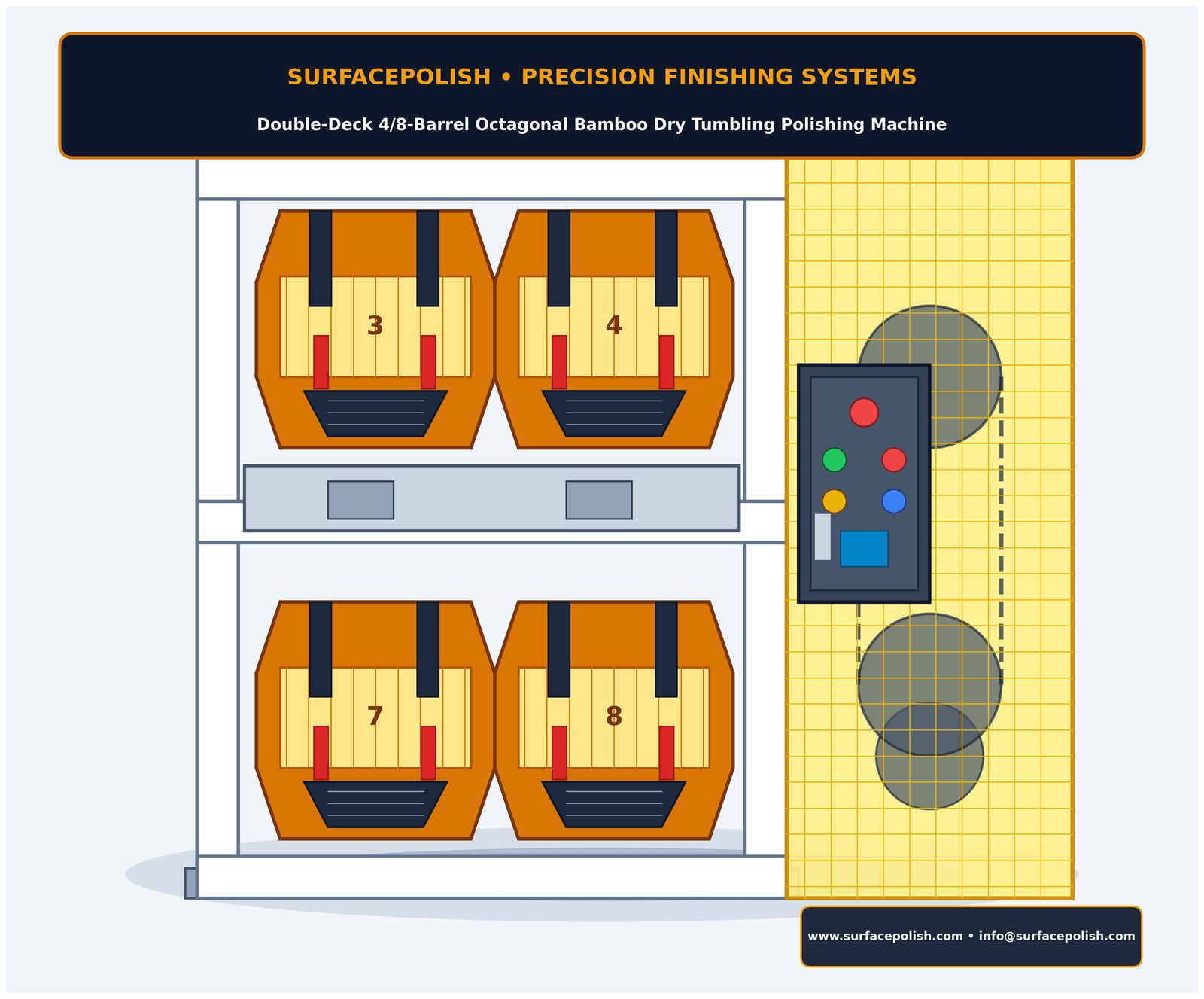
Dieses Handbuch beschreibt die Maschinenstruktur, die Bedienung des Bedienfelds, die vollständige 6-stufige Standardarbeitsanweisung (SOP), bewährte Trockentrommelrezepte, vorbeugende Wartung und schnelle Fehlerbehebung. Wenn Sie zunächst verschiedene Geräteoptionen vergleichen, lesen Sie bitte unsereRotationstrommel-TrommelmaschinenBereich oder die breitereSammlung von OberflächenbearbeitungsmaschinenDie
Geräteübersicht & Leistungsfähigkeit.Die zweistöckige, vertikale Bauweise spart Stellfläche und verdoppelt gleichzeitig die Chargenleistung. Jede Trommel besteht aus gealterten, natürlichen Bambusstäben mit Belüftungsgittern aus Edelstahl, und das Antriebssystem ist durch ein durchgehendes, gelbes Drahtgitter geschützt. Die Maschine eignet sich für Brillenfassungen aus Acetat/Propionat, hochwertige Beschläge, Schmuck und luxuriöse Kunststoff-/Holzkomponenten.
1. Technische Parameter & Konfiguration
Die folgende Tabelle listet die Standard-Ausführungskonfiguration der Modelle SP-TB4 (4-läufig) und SP-TB8 (8-läufig) auf.
| Technischer Parameter | Technische Spezifikation / Konfiguration |
| Struktur / Fässer | Doppeldecker (2 Ebenen), 4 oder 8 achteckige Bambusfässer |
| Laufmaterial | Gealterte, natürliche Bambusstäbe mit Edelstahl-Belüftungsfiltern |
| Hauptmotor / Stromversorgung | Hochleistungsmotor mit hohem Drehmoment (2,2 kW / 3,0 PS) (380 V 3-phasig / 220 V 1-phasig) |
| Taumelgeschwindigkeit | 28 – 35 U/min (Optimierter Schwerkraftkaskadenwinkel: 45°–50°) |
| Steuerungssystem | Digitaler Mikroprozessor-Timer (0–99,9 h/min), Start, Stopp, Tippbetrieb, Reset |
| Sicherheitsgehäuse | Industrielle Schutzabdeckung aus gelbem Drahtgitter in voller Höhe |
| Entladungssystem | Hochleistungsfähiger, mittig angeordneter, verzinkter, herausziehbarer Auffangbehälter |
| Offizielle Unterstützung | Webseite:www.surface-polish.com| E-Mail:info@surface-polish.com |
2. Maschinenstruktur & Bauteilnomenklatur
Die Maschine ist platzsparend zweistöckig vertikal aufgebaut. Diagramm und Tabelle unten zeigen alle primären Bauteile und ihre genauen englischen Fachbegriffe.

| # | Komponente | Funktionsbeschreibung & operative Rolle |
| 1 | Bambusbecher | Doppeldeck-Achtkantzylinder (Nr. 3, Nr. 4 oben; Nr. 7, Nr. 8 unten) für sanftes, kaskadenartiges Trockenpolieren. |
| 2 | Klemmstangen und Riegel | Hochleistungsfähige Stahl-Druckstangen mit schnell wirkenden Kniehebelklemmen zur Sicherung von Lukentüren. |
| 3 | Belüftungsgitter | Perforierte Edelstahlsiebe zur Ableitung von innerer Reibungswärme und zum Abführen von Feinstaub. |
| 4 | Auffangbehälter | Mittlere, dickwandige, verzinkte Auffangwanne für sauberes und schnelles Entleeren von Werkstücken/Medien. |
| 5 | Stahlrahmenkonstruktion | Starrer, schwingungsgedämpfter Schweißstahlrahmen zur Aufnahme von zweistufigen Antriebslasten. |
| 6 | Gelbe Sicherheitsnetz-Umzäunung | Gelber Drahtgitterkäfig in voller Höhe zur Isolierung von Antriebsriemen, Riemenscheiben und Antriebsketten. |
| 7 | Elektrischer Schaltschrank | Staubdichtes elektrisches Gehäuse mit Drucktasterstation, Sicherheitsverriegelungen und LED-Timer. |
3. Bedienfeld und Bedienerschnittstelle
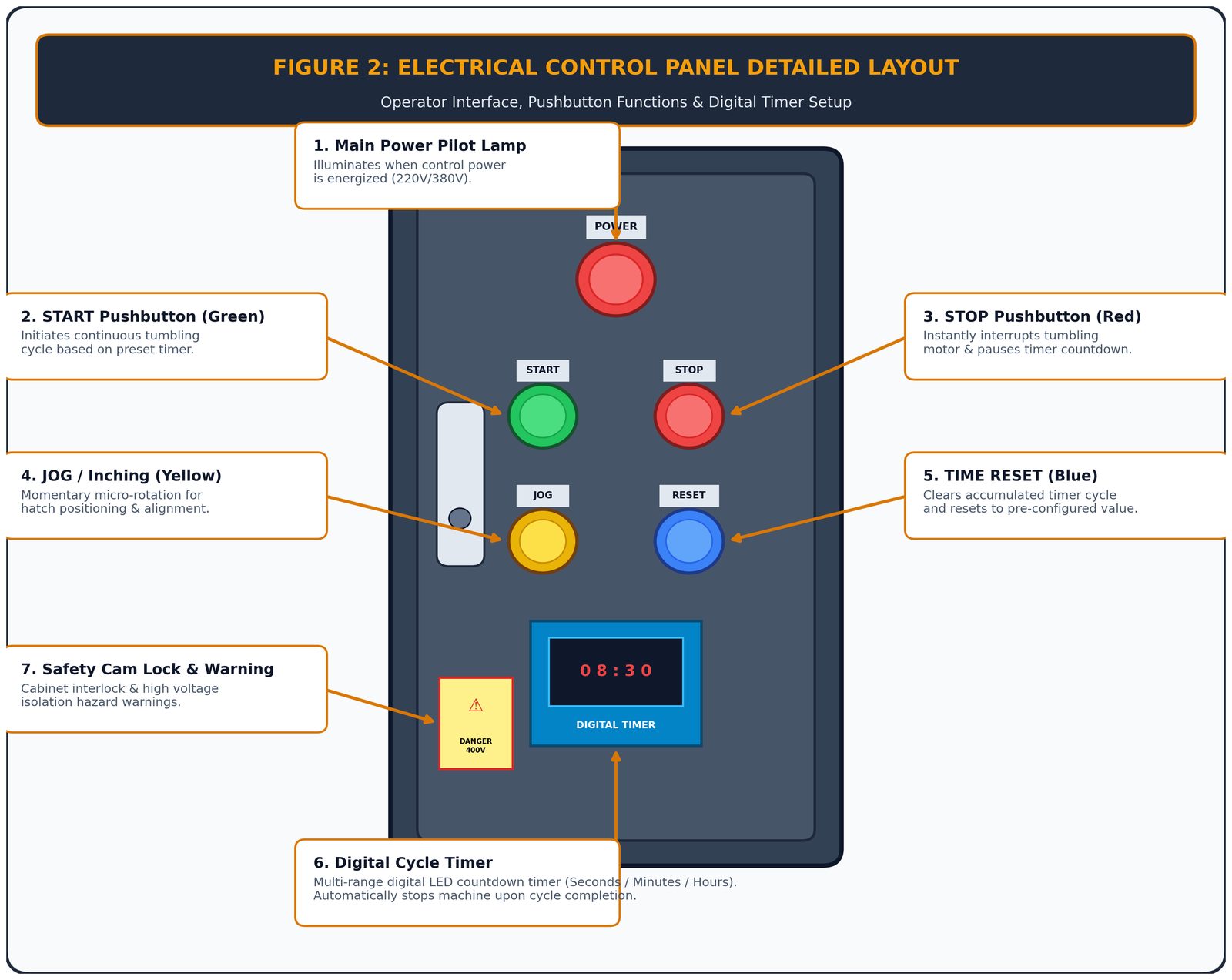
Die frontseitig angebrachte Steuereinheit ermöglicht präzises Zyklusmanagement, automatische zeitgesteuerte Abschaltung und Mikropositionierung (JOG) zum Be- und Entladen. Der digitale Timer stoppt die Maschine automatisch nach Abschluss des programmierten Zyklus.
| Steuerelement | Hardwaretyp / Farbe | Betriebslogik und Standardmaßnahmen |
| Betriebslampe | Rote Kontrollleuchte (oben) | Leuchtet dauerhaft, wenn die 3-phasige/einphasige Hauptstromversorgung eingeschaltet ist. |
| Startknopf | Grüner Druckknopf | Verriegelt den Hauptmagnetkontakt, um einen kontinuierlichen automatischen Taumelzyklus zu starten. |
| Stopptaste | Roter Druckknopf | Der Antriebsmotor wird sofort stromlos geschaltet und die Drehung des Zylinders vollständig gestoppt. |
| JOG / Inching | Gelber Druckknopf | Momentanlauf: Dreht die Fässer nur, solange die Taste gedrückt wird. Wird verwendet, um Türen zum Be- und Entladen auszurichten. |
| Timer zurücksetzen | Blauer Druckknopf | Setzt den digitalen Timer-Akkumulator für einen neuen Zykluslauf auf Null (00:00) zurück. |
| Digitaler LED-Timer | Mikroprozessorsteuerung | Digitalanzeige mit +/- Einstelltasten. Schaltet die Maschine nach Programmende automatisch ab. |
VORSICHT – JOG-Sicherheitsregel (Schrittweises Fahren).Zum Drehen der Fasstüren in Position immer die gelbe JOG-Taste verwenden. Versuchen Sie NIEMALS, die Fässer von Hand zu drehen, wenn der Motor angehalten oder eingeschaltet ist, da Restdrehmomente Quetschgefahren verursachen können.
4. Standardarbeitsanweisung (6-stufige SOP)
Befolgen Sie diesen optimierten 6-stufigen Arbeitsablauf, um wiederholbare Polierergebnisse in Spiegelqualität zu gewährleisten und maximale Bedienersicherheit sicherzustellen.

Schritt 1: Vorstartprüfung & JOG-Positionierung.
Verify the yellow safety cage is secured. Turn on the main isolator. Press the yellow JOG button intermittently until the target barrel door faces vertically upward (12 o’clock position).
Step 2: Load Polishing Media & Workpieces.
Release the red toggle latches, remove clamping bars, and open the hatch. Fill the barrel to 50%–60% total volume with walnut shells or corncobs. Add workpieces at a strict 3:1 to 4:1 media-to-workpiece ratio.
Step 3: Apply Polishing Wax / Rolling Cream.
Distribute specialized polishing wax or rolling oil evenly across the media (15–30 g per batch). Ensure the ventilation screens are clean and unclogged.
Step 4: Secure Clamping Bars & Latches.
Reinstall the barrel hatch door. Position the steel clamping bars and engage the red toggle clamps until firmly locked. Verify zero clearance around the door gasket.
Step 5: Program Digital Timer & Press START.
Press the blue TIMER RESET button. Set the desired cycle duration on the digital timer (e.g. 12.0 hours). Press the green START button. The machine runs continuously and auto-stops upon completion.
Step 6: Discharge & Workpiece Separation.
Slide the galvanized receiving hopper drawer directly under the target barrel. Use the JOG button to rotate the barrel door downward (6 o’clock position). Release the latches, open the hatch, and discharge the contents into the hopper for screening.
5. Dry Tumbling Process Recipes & Media Matrix
Dry tumbling relies on progressive multi-stage micro-cutting and buffing. Use the proven recipe chart below for acetate eyewear, luxury plastics, and precision metals. Cycle times are typical starting ranges and should be confirmed with sample parts.
| Process Stage | Recommended Media | Polishing Compound | Cycle Time | Surface Objective |
| 1. Rough Cutting | Coarse Walnut Shell (16#–20#) | Rough Cut Wax / Gray Paste | 8 – 14 Hours | Removes CNC milling marks, burrs, and parting lines. |
| 2. Medium Smoothing | Medium Walnut Shell (24#–36#) | Medium Polish Cream / Brown Wax | 10 – 16 Hours | Smooths micro-scratches, creates uniform satin finish. |
| 3. Fine Glossing | Fine Corncob (20#–40#) / Bamboo Pegs | Fine Buffing Oil / White Wax | 12 – 18 Hours | Enhances surface depth, semi-bright luster, prepares for mirror finish. |
| 4. High Mirror Luster | Micro Corncob (40#–60#) / Hard Pegs | Mirror Finish Glaze / Blue-Green Wax | 14 – 24 Hours | Produces flawless, ultra-deep optical clarity & mirror reflection. |
Pro tip — tumbling volume & density control.Optimal tumbling efficiency occurs at 50%–60% total barrel fill. Never underfill (below 40%, risks severe impact damage) or overfill (above 70%, prevents cascading action and causes matte dead spots).
Die Wahl des Schleifmittels und der Polierpaste hat den größten Einfluss auf die Ergebnisse des Trockentrommelns. Stöbern Sie in unserem Angebot.Trockene PoliermedienSortiment für Walnussschalen- und Maiskolbenqualitäten oder ÜberprüfungOberflächenbehandlungenfür bühnengerechte Wachse und Glasuren.
6. Vorbeugende Wartung und schnelle Fehlerbehebung
6.1 Regelmäßiger Wartungsplan
- Tägliche Kontrolle:Prüfen Sie die Türklemmbänder und Gummidichtungen auf Verschleiß. Entfernen Sie angesammelten Staub von den Lüftungsgittern mit einer weichen Bürste oder einem Staubsauger.
- Wöchentlicher Check:Prüfen Sie die Spannung des Antriebsriemens im gelben Siebkäfig (ca. 10–12 mm Durchbiegung bei festem Daumendruck). Prüfen Sie die Kettenschmierung.
- Monatlicher Service:Alle Stehlager mit Lithiumfett der Güteklasse NLGI #2 über die Schmiernippel fetten. Die Bambusstäbe auf festen Sitz prüfen; gegebenenfalls die Befestigungsschrauben nachziehen.
6.2 Matrix zur schnellen Fehlerbehebung
| Fehlersymptom | Wahrscheinliche Ursache | Korrekturmaßnahme / Lösung |
| Die Maschine startet nicht, wenn START gedrückt wird. | Hauptstromversorgung ausgeschaltet / Not-Aus aktiviert / Zeitschaltuhr nicht eingestellt / Sicherung durchgebrannt | Prüfen Sie die rote Betriebsanzeige, lassen Sie den Stoppknopf los, stellen Sie den Timer zurück und prüfen Sie den Sicherungsautomaten. |
| Die JOG-Taste funktioniert, aber die START-Taste rastet nicht ein. | Zeitüberschreitung / Fehler am Hilfskontakt des Schützes | Drücken Sie die blaue Timer-Reset-Taste; überprüfen Sie die Schützverdrahtung im Inneren des Steuerkastens. |
| Übermäßige Geräusche oder Vibrationen während des Betriebs | Verschleißtes Stehlager / lockere Antriebskette / ungleichmäßige Belastung | Lager schmieren oder austauschen, Kettenspanner einstellen, gleichmäßige Medienbefüllung sicherstellen. |
| Medienstaub tritt während des Betriebs aus | Abgenutzte Lukendichtung / Kniehebelklemmen nicht vollständig eingerastet | Silikondichtung prüfen und gegebenenfalls ersetzen; Spannung der Klemmstangenverriegelung einstellen. |
| Die Werkstücke weisen ungleichmäßigen oder mangelhaften Glanz auf | Falsches Medienverhältnis / unzureichende Wachsmenge / verstopfte Siebe | Stellen Sie das Verhältnis von Filtermaterial zu Werkstück auf etwa 4:1 ein; reinigen Sie die Lüftungsgitter, um eine Überhitzung zu vermeiden. |
7. Technischer Support & Entwicklung kundenspezifischer Prozesse
Für technische Unterstützung, die Entwicklung kundenspezifischer Trommelpolierprozesse, Ersatztrommeln oder Anfragen zu Ersatzteilen wenden Sie sich bitte an unser Engineering-Support-Team. Wir bieten außerdem OEM/ODM-Anpassungen, Polierpasten und -medien sowie Verschleißteile für die gesamte SP-TB-Serie an.
Benötigen Sie ein maßgeschneidertes Trockentrommelverfahren für Ihre Teile?
Senden Sie uns bitte Ihre Materialangaben, Abmessungen, den aktuellen Oberflächenzustand und die gewünschte Oberflächenbeschaffenheit. Unser Team für Oberflächenbearbeitung empfiehlt Ihnen dann die passende Maschine, die geeigneten Medien, die richtige Politur und das optimale Prüfverfahren.
Kontaktieren Sie unser Finishing-TeamOffizielle Website:www.surface-polish.com | Support-E-Mail:info@surface-polish.com
 +86-592-2381506


 IPv6-Netzwerk unterstützt